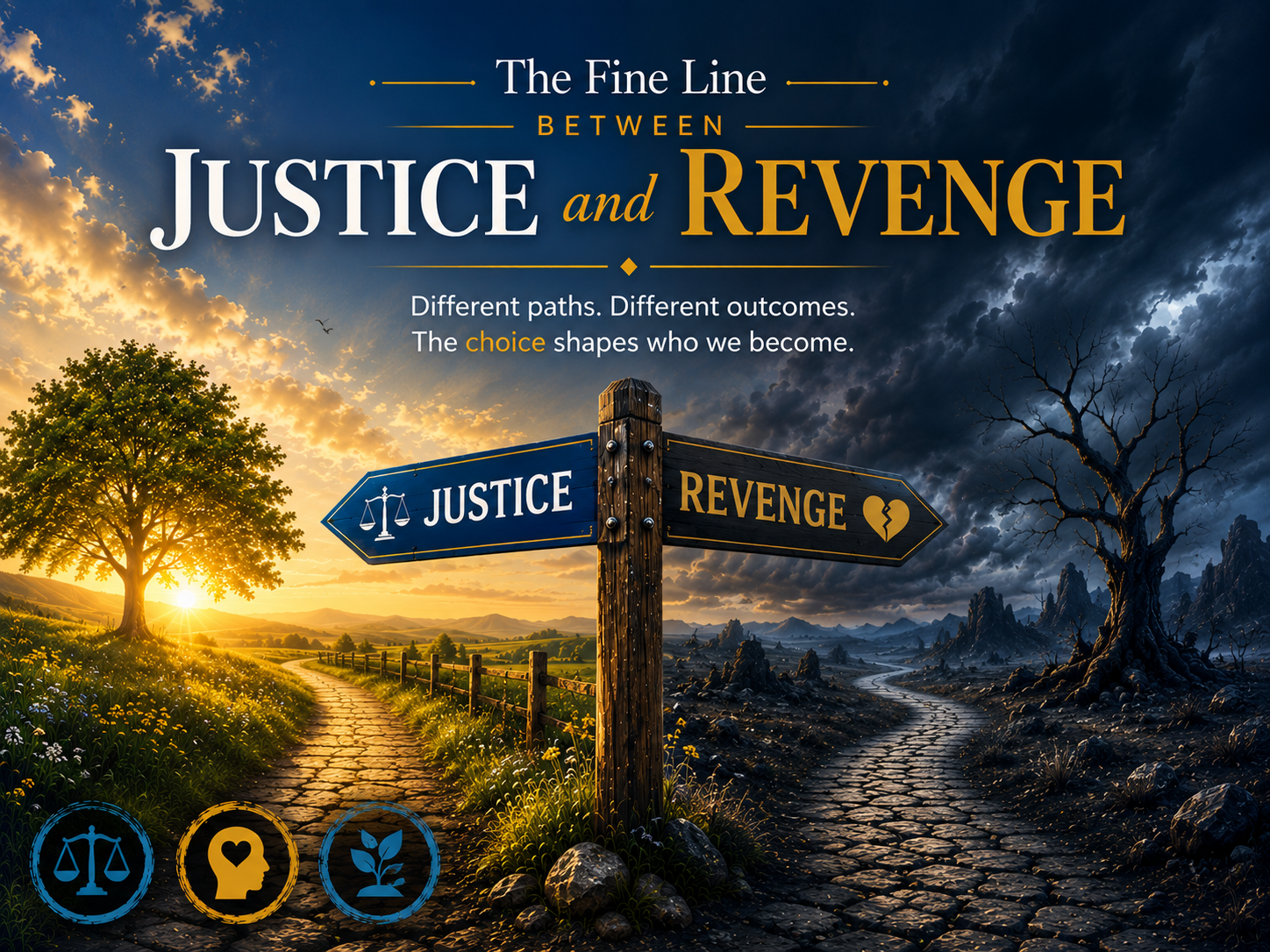
The Fine Line Between Justice and Revenge
Most people believe they would know the difference between justice and revenge if they ever faced a difficult situation. Justice feels noble. Revenge feels destructive. Yet in reality the line separating the two is often much thinner than we imagine.
When someone hurts us, betrays our trust or changes the course of our lives, our first instinct is rarely to seek fairness. We want them to feel what we felt. We want balance to be restored not always through the law but through consequences that satisfy our emotions.
This conflict has fascinated psychologists, philosophers and storytellers for centuries because it speaks to one of the most complex parts of human nature: our desire to make things right while wrestling with the temptation to make others suffer.
What Is Justice?
Justice is built on accountability. Its purpose is not to punish for the sake of punishment but to restore fairness, protect others and encourage responsibility.
A just response asks questions like:
What actually happened?
Who was harmed?
What consequences are appropriate?
How can future harm be prevented?
Justice looks forward. It seeks resolution rather than satisfaction.
Whether it’s a courtroom, a school disciplinary hearing or an honest conversation between two people, justice attempts to separate emotion from decision making. It recognises that while anger is understandable it shouldn’t be the only voice making the decision.
What Is Revenge?
Revenge begins where justice becomes personal.
Instead of asking, What is fair?, revenge asks, How can I make them feel what I felt?
That shift changes everything.
Revenge is often fuelled by humiliation, betrayal, rejection or years of unresolved pain. It promises relief, yet studies in psychology suggest that acting on revenge rarely brings lasting peace. Instead it often keeps people emotionally connected to the very event they wish they could move beyond.
The person seeking revenge may believe they are reclaiming control, but in many cases, they remain trapped by the past.
Why the Line Becomes Blurry
Life is rarely black and white.
Imagine someone who was bullied throughout childhood. Years later, they become successful while the people who hurt them struggle. If they expose those former bullies publicly, are they seeking justice or revenge?
The answer depends on motivation.
If the goal is accountability, protecting others or revealing ongoing wrongdoing, justice may be at work.
If the goal is humiliation, emotional satisfaction or making someone suffer simply because they once caused pain, revenge has likely taken over.
The same action can appear identical on the surface while being driven by completely different intentions.
The Psychology Behind Holding On
Humans naturally search for closure.
When we experience unfair treatment, our brains continue replaying the event, searching for an ending that feels complete. Unfortunately, life rarely provides perfect endings.
This is why many people spend years imagining conversations they never had victories they never achieved or apologies they never received.
Psychologists often refer to this as unfinished emotional processing. Without resolution, resentment can quietly grow, influencing future relationships, career decisions and even self worth.
Ironically the person who caused the original pain may have moved on long ago while the injured person continues carrying the emotional burden.
Can Revenge Ever Feel Satisfying?
Stories often portray revenge as deeply satisfying.
Reality is far more complicated.
Research suggests that people who achieve revenge frequently continue thinking about the original event rather than moving past it. Instead of providing closure, revenge can reinforce painful memories by keeping them emotionally active.
That doesn’t mean accountability isn’t necessary.
It means emotional healing and external consequences are not always the same thing.
Someone can face appropriate consequences while the injured person still has to do the difficult work of healing.
Why Redemption Matters
One of the greatest questions in literature is whether people can truly change.
Some believe that once someone crosses a moral line they remain defined by their worst actions forever.
Others argue that genuine accountability, self awareness and difficult choices can lead to transformation.
Redemption is not forgetting the past.
It is facing it honestly.
It requires accepting responsibility rather than making excuses. It demands growth instead of denial.
Most importantly, redemption never erases the damage that was done. Instead, it asks whether a person is willing to become someone different despite that history.
Stories That Explore Both Sides
The most memorable psychological dramas rarely offer simple heroes and villains.
Instead, they introduce deeply flawed individuals whose motivations constantly challenge the reader.
A person seeking justice may slowly become consumed by revenge.
A manipulative individual may unexpectedly reveal genuine compassion.
Someone who appears beyond saving may discover a path toward redemption.
These morally complex stories remind us that human behaviour is rarely defined by a single decision. People are shaped by childhood experiences, trauma, shame, ambition, fear and countless moments that influence who they eventually become.
That complexity is what makes psychological fiction so compelling it encourages readers to question not only the characters’ choices but also their own.
When Justice and Revenge Collide
One novel that explores this moral tension with remarkable depth is The Smallest of Miracles by Douglas Carpenter.
Some of the most powerful psychological stories don’t tell us who deserves forgiveness or punishment, they ask us to decide for ourselves. By exploring characters shaped by childhood trauma, hidden guilt, manipulation and difficult moral choices, these stories reveal how easily the pursuit of justice can slip into a desire for revenge. They remind us that people are rarely defined by a single decision and that redemption often begins with the courage to confront the past rather than rewrite it.
The Choice We All Face
Justice and revenge often begin with the same wound but lead to very different destinations.
Justice seeks accountability while allowing room for healing.
Revenge seeks emotional satisfaction even if it comes at the cost of lasting peace.
Understanding the difference doesn’t mean ignoring wrongdoing or pretending the past never happened. It means recognising that true strength often lies not in making someone else suffer but in deciding what kind of person we choose to become after we’ve been hurt.
Perhaps the hardest question is not whether others deserve forgiveness or consequences but whether we can move forward without allowing our deepest wounds to define the rest of our lives.